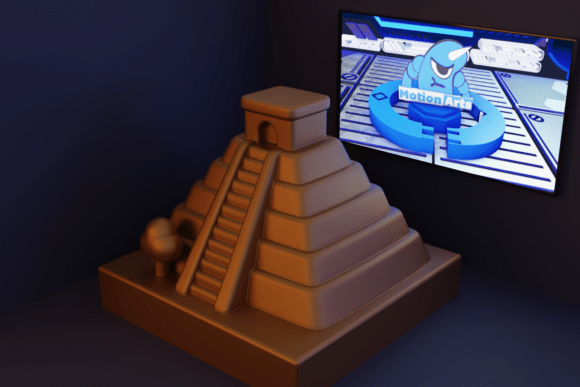
Understanding the Mesoamerican Pyramid: A Guide to History, Design, and 3D Replication
The Mesoamerican pyramid stands as one of the most recognizable architectural forms in human history. Distinct from the smooth-sided pyramids of Egypt, these structures are characterized by steep staircases, temple summits, and a stepped profile that reflects a deep integration of astronomy, religion, and urban planning. For modern enthusiasts, educators, and collectors, the interest in these monuments has evolved from purely academic study to tangible engagement through digital fabrication. The emergence of minimalist 3D models allows individuals to hold a piece of this ancient history, offering a bridge between complex archaeological heritage and contemporary design aesthetics.
Defining the Distinctive Features of Mesoamerican Architecture
To appreciate a Mesoamerican pyramid model, one must first understand the structural and symbolic elements that define the original monuments. Unlike their Egyptian counterparts, which were primarily tombs for pharaohs, Mesoamerican pyramids served as platforms for temples and ceremonial centers. They were active parts of the city, often built over previous iterations, creating massive earthworks capped with stone.
The defining characteristics include:
- Stepped Profiles: The exterior is composed of receding tiers or steps, symbolizing the layers of the cosmos or the ascent to the divine.
- Ceremonial Staircases: Broad, steep stairs usually face the cardinal directions, leading to a summit temple where rituals were performed.
- Integration with Nature: Many sites, such as Chichén Itzá or Teotihuacán, were aligned with celestial events, particularly solstices and equinoxes.
- Materiality: Originally constructed from limestone, stucco, and local stone, these structures were often brightly painted, contrasting sharply with the monochromatic perception of today.
When evaluating a 3D representation, the goal is not merely to replicate the shape but to capture the essence of these geometric proportions. A well-designed model simplifies the intricate carvings and weathering of the originals while maintaining the harmonious ratios that made these structures visually commanding.
Evaluating Minimalist 3D Models Against Traditional Replicas
In the realm of historical modeling, consumers generally encounter two primary categories: hyper-realistic replicas and minimalist interpretations. Each serves a different purpose and appeals to different needs.
The Case for Hyper-Realism
Traditional high-detail models focus on texture, erosion, and specific archaeological accuracy. These are often used in museums or by serious historians who require precise data regarding surface wear and specific iconography. While valuable for research, these models can be heavy, expensive to print, and sometimes overwhelming in a modern interior setting due to their chaotic visual noise.
The Advantages of the Minimalist Approach
A minimalist Mesoamerican pyramid model takes a different approach. By stripping away non-essential details and focusing on clean lines and geometric purity, this style highlights the underlying mathematical precision of the ancient architects. This approach offers several distinct benefits:
- Visual Clarity: The simplified form makes the structure's proportions immediately apparent, serving as an excellent educational tool for explaining architectural concepts.
- Design Versatility: The clean aesthetic fits seamlessly into modern decor, blending with Scandinavian, industrial, or contemporary styles without clashing.
- Print Efficiency: Reduced detail means faster print times, less material usage, and fewer potential points of failure during the printing process.
For the average collector or educator, the minimalist version often provides a better balance between artistic appreciation and practical utility. It transforms a historical artifact into a sculptural object that invites contemplation rather than just observation.
Technical Considerations for Printing Mesoamerican Structures
When deciding to produce a physical copy of a Mesoamerican pyramid, understanding the technical requirements is crucial for a successful outcome. Most digital files for these models are provided in STL format, which is universally compatible with slicing software.
Choosing Between FDM and Resin Printers
The choice of printer significantly impacts the final result. Fused Deposition Modeling (FDM) printers are ideal for beginners and those seeking larger, durable models. They handle the solid, blocky nature of a pyramid well, though layer lines may be visible unless post-processed. Conversely, Stereolithography (SLA) resin printers offer superior surface finish and finer detail, capturing the subtle angles of the steps more accurately. However, resin requires more safety precautions and post-curing.
Both technologies are compatible with standard pyramid designs, but the decision often comes down to the desired scale and finish. For a desk ornament, resin might be preferred for its sleekness. For a large statement piece, FDM offers structural integrity at a lower cost.
The Necessity of Support Structures
One critical factor in printing stepped structures like the Mesoamerican pyramid is the need for support. Due to the overhangs created by the receding tiers, most models require support generation during the slicing phase. While this adds time to the print and requires removal afterward, it ensures that the sharp edges of the steps remain crisp rather than sagging. Beginners should note that proper orientation—printing the pyramid upright—is essential to minimize support usage and maximize stability.
Use Cases: Education, Decoration, and Collection
The versatility of a Mesoamerican pyramid model extends beyond simple decoration. Its application varies based on the user's intent.
Educational Applications
In classrooms and workshops, these models serve as powerful tactile aids. Students can physically manipulate the structure to understand concepts of volume, symmetry, and ancient engineering. The simplified geometry allows learners to focus on the fundamental layout without being distracted by complex surface textures. Teachers can use the model to demonstrate how the Maya and Aztec civilizations integrated mathematics and astronomy into their daily lives.
Modern Interior Design
For home and office environments, the minimalist pyramid acts as a sophisticated accent piece. Its geometric form complements other modern art objects, bookends, or tech accessories. Unlike cluttered figurines, a clean-lined pyramid conveys a sense of order and history. It works particularly well in spaces dedicated to study, strategy, or reflection, acting as a subtle nod to the enduring legacy of ancient civilizations.
Collector's Items
Collectors of historical monuments often seek unique representations that differ from mass-produced souvenirs. A custom-printed, high-quality STL file allows for personalization in color, size, and material. Whether printed in PLA, PETG, or cast in metal later, the model becomes a curated item that reflects the owner's appreciation for both history and design.
Decision Factors: When to Choose a Minimalist Model
Determining whether a minimalist Mesoamerican pyramid is the right choice depends on your specific goals. If your priority is absolute archaeological fidelity for a museum exhibit, a highly detailed, textured scan might be more appropriate. However, for the vast majority of users, the minimalist approach offers the best tradeoff.
Consider this option if:
- You value clean aesthetics and modern design principles.
- You are working with limited printing resources or time.
- You need a model that is easy to assemble and display.
- Your goal is to inspire curiosity about history without overwhelming the viewer.
Conversely, if you require specific inscriptions, glyphs, or weathering effects for a specialized project, you may need to look for more complex datasets or consider modifying the base model. Yet, even then, starting with a solid, stable minimalist base often provides a better foundation for customization than trying to simplify a hyper-realistic mesh.
Conclusion: Bridging Past and Future
The Mesoamerican pyramid remains a testament to human ingenuity and spiritual aspiration. Through the lens of modern technology, specifically 3D printing, we can reinterpret these ancient icons in ways that resonate with contemporary sensibilities. A minimalist 3D model does not diminish the grandeur of the original; instead, it distills it into its purest form, allowing us to engage with history in a new, tangible way.
Whether used to educate the next generation, enhance a living space, or simply celebrate the beauty of geometric architecture, these models offer a meaningful connection to the past. By balancing artistic style with cultural authenticity, they stand as a modern tribute to the civilizations that once shaped the world, proving that the lessons of antiquity can be reimagined for the future.